Can Shaftless Elevators Reach Three Floors? What Homeowners Should Know
July 27, 2026
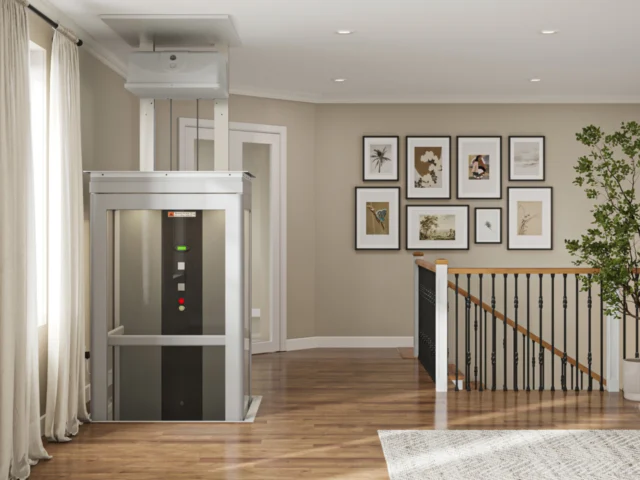
Some shaftless home elevators can serve three floors, but most are engineered specifically for travel between two floors. Three-stop shaftless models are less common and require equipment expressly designed for the additional travel, floor openings, landings, and safety requirements.
The current Pollock Residential Elevator is a two-floor, two-stop system. It provides up to approximately 13 feet 9 inches of standard travel, with an extended-travel option of up to 15 feet 9 inches. It is not designed to stop at three different floors.
If a home has three stories, staggered levels, or a basement plus two living floors, a traditional residential elevator, machine-room-less elevator, or another multi-stop system may be more appropriate. A professional site assessment can determine whether one elevator, multiple accessibility solutions, or a different design will provide the safest and most convenient access.
What Is a Shaftless Elevator?
A shaftless elevator is a compact residential lift that travels between floors without a traditional enclosed hoistway, deep pit, or separate machine room. It generally follows supporting guide rails and passes through a protected opening in the floor.
Shaftless elevators are also called through-the-floor elevators because the cabin moves through a fitted floor aperture. When the cabin travels to the opposite level, an integrated floor liner or trapdoor closes the opening.
This design makes shaftless elevators especially useful for:
- Existing-home retrofits
- Two-story homes
- Aging-in-place projects
- Homes with limited space
- Projects where minimizing construction is important
- Homeowners who want to preserve more of the existing floor plan
Their compact design provides placement flexibility, but it also creates practical and regulatory travel limits.
How Many Floors Can a Shaftless Elevator Serve?
Most shaftless home elevators are designed to connect two floors with two stops. One stop is located at the lower level, and the other is located directly above it.
A limited number of manufacturers offer three-floor models. These systems require additional travel capacity, controls, floor openings, safety protections, and manufacturer-specific engineering. Availability and approval vary by location.
| Feature | Typical two-floor shaftless elevator | Select three-floor shaftless elevator |
| Number of stops | Two | Three |
| Floor openings | One | Two |
| Vertical alignment | Required between two levels | Required through all three levels |
| Travel height | Commonly around 13–16 feet | Greater travel; model-specific |
| Installation complexity | Relatively low | Higher |
| Structural work | One floor aperture and required support | Two floor apertures and additional coordination |
| Code review | Required | Often more complex |
| Product availability | Widely available | Limited |
| Typical cost | Pollock notes that residential elevators commonly range from $25,000–$50,000 or more | Usually higher and determined by the product, site, and structural work |
The existence of a three-floor shaftless product does not mean every shaftless elevator can be extended. Guide rails, suspension systems, motors, controls, brakes, cables, and safety systems are engineered for specific maximum travel distances and numbers of stops.
A two-stop elevator should never be modified to serve an additional floor unless the manufacturer has designed, tested, and approved that exact configuration.
How Far Can a Pollock Shaftless Elevator Travel?
The Pollock Residential Elevator is designed to provide through-floor access between two levels.
Current specifications include:
- Two-floor, two-stop travel
- Up to approximately 13 feet 9 inches of standard travel
- Optional extended travel up to 15 feet 9 inches
- 500-pound capacity
- 16-feet-per-minute rated speed
- Three cabin footprint options
- 115V power supply with a 20-amp breaker
- Rope-suspension drive system
- Emergency battery backup and battery lowering
The extended travel option can accommodate homes with higher ceilings or a greater distance between two landings. It does not add a third stop.
That distinction matters: Travel distance describes how far the cabin moves, while number of stops describes how many landings it serves. A two-stop elevator with extended travel can connect two widely separated floors, but it cannot stop at an intermediate level.
Explore current dimensions and features on the Pollock Residential Elevator range page.
Can a Shaftless Elevator Work in a Three-Story Home?
Yes—a shaftless elevator can still be useful in a three-story home if access is only needed between two of its floors.
For example, a homeowner might install a two-stop elevator between:
- The first and second floors
- A basement and main floor
- The main floor and primary bedroom level
- A garage-adjacent lower level and main living area
The remaining level would need another safe access method. Depending on the user’s mobility, that might include stairs, a stairlift, or a second lift.
The better question is not simply, “How many stories does the house have?” It is, “Which floors must the user be able to reach independently?”
If all three floors require step-free access, choose equipment specifically approved for three stops or consider a traditional multi-floor residential elevator.
Shaftless Elevators in Split-Level and Staggered Homes
Split-level homes create a special planning challenge because their floors may be separated by shorter staircases but offset horizontally.
A shaftless elevator travels in a straight vertical path. It cannot angle, turn, or shift sideways to follow staggered levels. Every landing must align with the elevator’s rails and cabin path.
Important Split-Level Considerations
Vertical alignment
The proposed elevator location must align with usable space at every landing. Two rooms may seem close on a floor plan without sitting directly above one another.
Number of required stops
A split-level home may have three or four elevations even if it appears to be a two-story structure. Determine which levels need elevator access before selecting equipment.
Total travel
Measure the vertical distance between the lowest and highest required landings. Compare it with the manufacturer’s maximum approved travel.
Floor-opening requirements
A two-stop through-floor elevator requires one floor aperture. A three-stop shaftless elevator generally requires a second opening and additional landing protection.
Structural support
Floor joists, beams, walls, plumbing, wiring, and HVAC systems may limit the available route.
Code approval
Local rules may restrict partially enclosed or shaftless configurations, particularly when multiple floor openings and stops are involved.
In some staggered homes, two separate short-rise solutions may be more practical than one three-stop elevator. In others, an enclosed multi-stop elevator may provide a cleaner and more usable route.
A Four-Step Evaluation for Three-Floor Access
Step 1: Identify who will use the elevator
Consider current and potential future needs:
- Will the user stand, sit, or use a wheelchair?
- Is space needed for a caregiver?
- Which rooms must remain accessible?
- Is independent access required to every floor?
- Could mobility needs change over time?
Step 2: Map the home’s vertical route
Identify spaces that align from the lowest level to the highest. Check room corners, hall ends, areas beside stairs, and underused spaces.
Do not rely on visual estimates alone. A professional must verify structural alignment and hidden obstacles.
Step 3: Review manufacturer specifications
Confirm:
- Maximum number of stops
- Maximum travel
- Rated capacity
- Cabin dimensions
- Required floor openings
- Power supply
- Installation environment
- Applicable certifications
A product page describing an elevator as “shaftless” or “multi-story” is not enough. Ask for the technical documentation for the exact model and configuration.
Step 4: Request an on-site assessment
An authorized dealer can review the structure, applicable codes, permits, user needs, and alternative solutions. This prevents homeowners from planning around equipment that cannot legally or physically work in the space.
Regulatory Considerations for Three-Stop Elevators
Residential elevators in the United States are governed by adopted building, electrical, and elevator codes. Requirements vary because states and local jurisdictions may use different editions of national standards or add their own rules.
Pollock elevators are ETL listed and designed to applicable ASME A17.1 and A17.5 requirements. Local officials still determine whether a particular installation and configuration may be approved.
A three-floor installation may involve additional requirements for:
- Landing doors and interlocks
- Floor-opening protection
- Emergency communication
- Electrical disconnects
- Structural support
- Cabin and travel clearances
- Fire separation
- Inspection and testing
- Maintenance access
- Permits and final approval
Many shaftless products are approved only for two-stop operation. If a manufacturer does not list a three-stop configuration in its official specifications, homeowners should assume the product cannot serve three floors.
Safety features to verify
Regardless of the number of stops, look for:
- Interlocked doors
- Obstruction sensors
- Pressure-sensitive top and bottom surfaces
- Constant-pressure controls
- Overspeed protection
- Emergency stop
- Battery lowering
- Emergency communication
- Diagnostic indicators
- Service-due notifications
- Recognized testing and certification
The Pollock Residential Elevator includes a bottom tray and trapdoor sensor, constant-pressure controls, battery lowering, an emergency telephone, an overspeed brake, and an in-cabin diagnostic display.
Maintenance for Shaftless Through-Floor Elevators
Shaftless elevator maintenance is generally straightforward for the homeowner, but technical inspection and repairs must be handled by qualified professionals.
Pollock recommends routine professional service to support reliable operation and identify developing wear. The appropriate schedule depends on the model, usage, local requirements, and service agreement, but annual inspection is a common baseline.
What a service technician may inspect
- Guide rails and supporting components
- Rope-suspension or drive components
- Door operation and interlocks
- Floor-opening and trapdoor protections
- Top and bottom safety sensors
- Battery backup and lowering functions
- Emergency telephone and alarm
- Cabin controls and landing remotes
- Electrical connections
- Diagnostic and fault records
- Brakes and stopping accuracy
- Fasteners and structural connections
Homeowner maintenance checklist
- Keep the cabin floor clean.
- Remove dust, pet hair, and debris from accessible areas.
- Keep the elevator’s travel path clear.
- Do not store items on top of or beneath the cabin.
- Check that doors close normally.
- Pay attention to diagnostic messages.
- Report unusual sounds, vibration, or changes in travel.
- Keep service contact information nearby.
- Never lubricate, adjust, or open mechanical components yourself.
If the elevator stops unexpectedly or displays a fault, follow the owner’s manual and contact the installing dealer. Do not repeatedly reset the equipment or bypass a safety device.
Learn more in Pollock’s residential elevator maintenance guide.
Where Should Shaftless Elevator Spare Parts Come From?
Replacement parts should come from the manufacturer or an authorized dealer. Elevator components are engineered and tested as part of a complete safety system, so visually similar aftermarket parts may not provide the correct fit, performance, or certification.
Parts that may require replacement during an elevator’s service life include:
- Cabin and landing controls
- Guide rollers
- Door interlocks
- Suspension ropes, belts, or related drive components
- Batteries and chargers
- Sensors and switches
- Control boards
- Emergency communication components
- Door operators
- Display or diagnostic components
OEM vs. aftermarket sourcing
| Source | Advantages | Risks or limitations |
| Manufacturer or authorized dealer | Correct specifications, documented compatibility, trained installation, warranty support | Must be ordered through approved service channels |
| General aftermarket supplier | May appear less expensive or readily available | Compatibility, certification, quality, and warranty concerns |
| Used or salvaged component | Potentially low initial price | Unknown condition, service history, and remaining life; generally inappropriate for critical safety components |
U.S. Pollock owners should contact their installing dealer or Pollock’s support network for service and parts. This helps preserve equipment compatibility and gives technicians access to appropriate documentation.
Sourcing Pollock parts in the UK
People searching for shaftless elevator spare parts in the UK can work directly with Pollock Lifts or its authorized service network. Pollock’s UK operation supplies spare parts nationwide and maintains a parts-management system supporting rapid distribution across the UK.
UK customers can request parts through the Pollock Lifts maintenance and repair service. Safety-related parts should be installed by a qualified engineer rather than purchased for DIY repair.
Benefits of a Maintenance Agreement
A maintenance agreement can simplify long-term ownership by creating a regular service schedule and clear support path.
Depending on the provider, a plan may include:
- Scheduled inspections
- Preventive maintenance
- Priority service
- Diagnostic testing
- Documented service history
- Direct access to OEM parts
- Emergency call-out options
- Repair-labor benefits
The exact coverage varies, so review what is included, which parts are excluded, how emergency calls are handled, and whether unused visits roll over.
A service agreement does not make an elevator maintenance-free. It makes the maintenance process more predictable—which is considerably more useful than discovering your service provider’s phone number during a fault.
Alternatives for Three-Floor Accessibility
If all three floors must be accessible and a two-stop shaftless model is insufficient, several alternatives may be available.
| Accessibility solution | Typical floor capability | Construction impact | Best suited for |
| Traditional hydraulic home elevator | Three or more stops | Higher; generally needs a hoistway and may require a pit or equipment space | Higher capacities and full multi-floor access |
| MRL traction elevator | Three or more stops | Requires an enclosed hoistway but no separate machine room | Multi-story homes seeking efficient, quiet travel |
| Three-stop shaftless elevator | Three stops on select approved models | Moderate; two floor openings and specialized engineering | Homes with clear vertical alignment and an approved product |
| Pneumatic vacuum elevator | Multiple stops on certain models | Lower to moderate; model- and code-dependent | Design-conscious retrofits with suitable capacity needs |
| Vertical platform lift | Model-dependent travel and landings | Moderate; may require an enclosure | Wheelchair access in suitable residential applications |
| Multiple stairlifts | Can address several stair flights | Lower structural impact | Users who can safely transfer and do not need wheelchair transport |
Costs vary widely by product, travel distance, capacity, location, structural work, finishes, and permits. A three-stop system will generally cost more than a comparable two-stop installation because it requires additional equipment, landing protection, labor, and code coordination.
Frequently Asked Questions
Can a shaftless elevator serve three floors reliably?
Select shaftless elevator models are designed for three-floor travel, but most standard through-the-floor elevators serve only two floors. A three-stop installation requires a product specifically engineered and approved for that configuration. The current Pollock Residential Elevator is a two-stop system.
What determines how many floors a shaftless elevator can reach?
The maximum number of floors depends on the manufacturer’s design, maximum travel, drive system, controls, floor-opening protections, and applicable local codes. Home layout and vertical alignment also affect feasibility.
Can Pollock’s shaftless elevator reach three floors?
No. The current Pollock Residential Elevator connects two floors and has two stops. Its optional extended travel increases the distance between those stops to approximately 15 feet 9 inches but does not add another landing.
Do shaftless elevators need a pit or full hoistway?
Most shaftless, through-the-floor elevators do not require a traditional enclosed hoistway or deep pit. They generally use guide rails, a fitted floor opening, and a shallow entry transition.
Can a shaftless elevator work in a split-level home?
Possibly. It can connect two vertically aligned levels within its approved travel range. If access is required at three staggered levels, a three-stop system, two separate solutions, or an enclosed residential elevator may be necessary.
How compact are shaftless elevators?
Shaftless elevators use less structural space than many traditional systems. Pollock currently offers three footprints, with its smallest model measuring approximately 31⅛ by 43¼ inches to the floor liner, plus required installation clearances.
How much does a shaftless home elevator cost?
Residential elevators commonly cost approximately $35,000 to $55,000 or more. Final pricing depends on cabin size, travel, electrical and structural work, permits, finishes, installation, and location. Three-stop systems generally cost more than standard two-stop models.
Choose the Number of Stops Before Choosing the Elevator
A three-story home does not automatically require a three-stop elevator—but every level essential to the user’s daily life needs a safe access plan.
For travel between two floors, Pollock offers a compact shaftless solution with minimal structural disruption, three cabin sizes, travel of up to approximately 15 feet 9 inches, and safety-focused features. For three-stop access, homeowners should evaluate equipment specifically designed and approved for that purpose.
A Pollock dealer can assess the home’s layout, floor alignment, accessibility needs, and local requirements. That early evaluation helps determine whether a two-stop Pollock elevator, another multi-floor elevator, or a combination of accessibility products will provide the best long-term solution. Get started today and contact a dealer near you for a free consultation!
Interested in Becoming a Distributor?
If you are looking to expand your product offerings or trying to reach a new market, then the Pollock Residential Elevator could be perfect for you. Reach out to our team to learn more.