What is an Aperture for a Home Elevator?
March 2, 2026
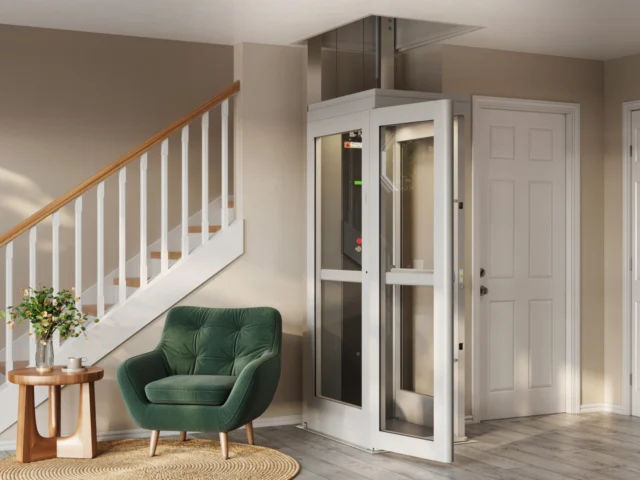
If you’ve started researching a through-floor lift or a through-the-floor elevator, you’ve likely come across the terms “aperture” and “shaftless home elevator.” It sounds technical, but the concept is surprisingly straightforward—and for many homeowners, refreshingly practical.
A shaftless home elevator is a compact residential lift that travels through a precisely cut opening in the floor—known as a floor aperture—connecting two levels without requiring a masonry shaft or full hoistway. When the lift is parked upstairs, the opening below is automatically sealed with an in-floor safety lid. When it’s downstairs, the upper level remains fully usable.
For homeowners exploring aging in place modifications, this style of compact home lift offers a vertical mobility solution that seamlessly balances space, design, and daily confidence—without overtaking the home.
Let’s walk through whether a through-floor lift makes sense for your home, your layout, and your long-term plans.
The Path to Home Accessibility
The “Vertical” Challenge
In many multi-story homes, stairs become the primary barrier long before anything else does. Arthritis, balance changes, reduced stamina, or fatigue can turn what used to be a simple trip upstairs into a calculated effort.
When stairs start limiting access to bedrooms, laundry rooms, or offices, families typically consider three options:
- Reconfigure living space downstairs
- Install a stairlift
- Add a vertical mobility solution like a lift or elevator
An aperture stands apart because it preserves the full function of both floors—without requiring a large shaft or mechanical room.
Overhead Clearance Considerations
Unlike full elevators that may require substantial overhead clearance, most aperture lifts are designed with standard residential ceiling heights in mind. However, your installer will assess:
- Ceiling height upstairs
- Structural joist layout
- Clearance for the drive system
A professional site survey ensures the installation integrates smoothly into your existing floor plan.
What is a Through-the-Floor Elevator?
A through-the-floor elevator is a self-contained lift that travels through a cut-out section of flooring—essentially a carefully engineered “hole-through-floor” concept.
How It Works
The lift moves vertically along self-supporting rails. When it’s at the upper level, the lower opening is automatically covered by a reinforced lid integrated into the base of the cab. When it descends, the upper level is sealed.
This vanishing-cab design is one of the key reasons homeowners prefer aperture systems in open-plan layouts.
Key Components
- The enclosed cab
- The floor aperture (precision-cut opening)
- Integrated drive system
- In-floor safety lid
- Safety underside sensors
- Control panel and emergency systems
Importantly, the installation is typically non-load-bearing. The lift supports itself rather than relying on a built shaft for structural strength.
Electrical & Mechanical Logistics
Powering Your Lift
Most through-floor elevators operate on a dedicated residential circuit, commonly 220V, though some models use 110V systems. A dedicated breaker ensures safe, uninterrupted performance.
Many systems also include battery backup wiring. In the event of a power outage, the lift can safely descend to the lower level rather than leaving a rider stranded.
Drive Systems: Hydraulic vs. Traction vs. Screw
When comparing hydraulic vs. traction drive systems, here’s the simplified difference:
- Hydraulic drive: Smooth and powerful, but often requires more space for equipment.
- Traction drive: Uses cables and counterweights, typically found in larger residential elevators.
- Screw or drum drive systems (like the Pollock Residential Elevator): Compact, self-contained, and ideal for retrofit home elevator applications.
Drive choice affects noise level, installation complexity, and long-term maintenance. Through-floor lifts are generally designed for quiet residential use—meaning you won’t feel like you’ve installed a freight lift in your living room.
Retrofitting: Integration into Existing Homes
The “Closet-to-Closet” Strategy
One popular retrofit strategy is stacking closets. By installing a through-floor lift in two aligned closets—one upstairs, one downstairs—homeowners preserve open living areas while gaining vertical access.
Cutting Joists Safely
Installing a floor aperture involves carefully cutting floor joists and reinforcing surrounding structure to maintain integrity. This is not a DIY project by any means—but it is a common and well-engineered solution when handled by certified installers.
Outdoor VPLs
If interior renovation isn’t desirable, an outdoor vertical platform lift can provide deck or porch access with minimal disruption. These systems often sit on a concrete pad and require very little structural modification.
Safety First: How Apertures Protect You
Because a through-floor lift literally moves through an opening, safety design is critical.
Safety Underside Sensors
If a pet, child, or object is beneath the lift, safety underside sensors immediately stop downward travel. These are essential in “hole-through-floor” systems.
Emergency Features
Most through-floor home elevators include:
- Manual lowering capability
- Battery backup
- Emergency stop buttons
- Interior alarm or phone system
Confidence comes from knowing the system anticipates real-life scenarios.
Installation: What to Expect
The Site Survey
A certified dealer will evaluate:
- Structural framing
- Ideal room placement
- Electrical access
- Wheelchair accessible models if needed
Construction Requirements
Unlike typical, larger elevators, you do not need a shaft or pit. That dramatically shortens installation time (and decreases cost and stress during planning and installation!).
Timeline
Most through-floor lift installations take 2–5 days, compared to several weeks for a full hoistway elevator.
Cost Analysis & ROI
The Cost of a Through-Floor Lift
The cost of a through-floor lift varies based on:
- Equipment model
- Electrical upgrades
- Structural reinforcement
- Finishes
Equipment typically represents a large portion of the investment, while labor depends on site conditions.
Value vs. Moving
When comparing the cost of moving, downsizing, or assisted living, a retrofit home elevator often preserves independence while protecting home equity.
A traditional shaft elevator may add luxury appeal. A through-floor elevator focuses on space-saving accessibility and practical long-term use.
Maintenance
Most residential lifts require annual inspection and routine maintenance to ensure longevity and code compliance.
FAQs
What exactly is a floor aperture?
A structural opening cut between two levels to allow the lift to pass through safely.
How long does installation take?
Typically 2–5 days after permits and equipment delivery.
Can it be installed anywhere?
Most rooms are possible, but structural framing and ceiling height determine feasibility.
What power supply is required?
Usually a dedicated 220V circuit, though specifications vary.
What happens to the opening when the lift is upstairs?
The in-floor safety lid seals the aperture.
What prevents the lift from descending on someone?
Safety underside sensors immediately stop travel upon obstruction detection.
What if the power goes out?
Battery backup systems allow safe descent.
Is it noisy?
Modern systems are engineered for quiet residential operation.
Can it accommodate a wheelchair?
Many models offer wheelchair accessible options and appropriate weight capacities.
How often is maintenance required?
Annual professional service is standard.
Final Thoughts: Reclaiming Your Home
A through-the-floor elevator isn’t about limitation—it’s about access. It’s about keeping every room usable. It’s about daily confidence. If stairs are starting to seem stressful, it may be time to explore a vertical mobility solution that fits your home—not the other way around.
The best way to know if a shaftless residential elevator is right for you is through a professional home assessment. A certified Pollock dealer can evaluate your space, answer your questions about construction and cost, and recommend the safest, most efficient solution for your needs. Contact a certified Pollock installer today, because your home should work for you. On every level.
Interested in Becoming a Distributor?
If you are looking to expand your product offerings or trying to reach a new market, then the Pollock Residential Elevator could be perfect for you. Reach out to our team to learn more.