There’s a moment most multi-story homeowners know well: Arms loaded with grocery bags, one foot already on the first step, dreading that climb. Or the slow shuffle of a parent visiting from out of town, gripping the handrail a little tighter than they used to. These are small moments—but they add up. A residential elevator doesn’t just help you travel between floors. It quietly transforms the way your home works for you, every single day.
At Pollock Residential Elevators, we’ve spent decades helping homeowners make that transformation—safely, beautifully, and with as little disruption to their home as possible. Here’s what changes when you install a home lift, from daily convenience to long-term property value.
Everyday Convenience and Safety Benefits
The most immediate impact of a home elevator is simple: You stop stressing over the stairs.
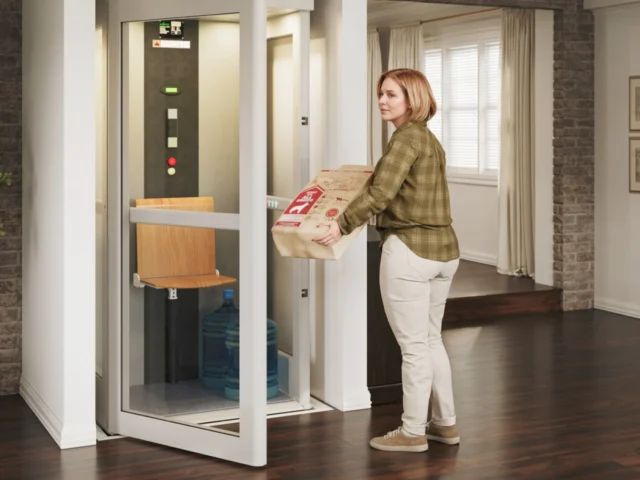
Carrying groceries, laundry baskets, suitcases, or heavy boxes between floors becomes a non-event. What once required multiple trips—or a risky balancing act on a staircase—becomes a single, effortless ride. That’s not a small thing. According to the CDC, falls are the leading cause of injury among older adults, and stairs are among the most common culprits. Fall risk—the likelihood of tripping or losing balance on stairs—is a real and serious concern, with older adults three times more likely to experience a traumatic stair fall than younger people.
A home elevator doesn’t just reduce that risk. It eliminates the scenario entirely.
Key convenience and safety benefits at a glance:
- Move groceries, laundry, luggage, and heavy items between floors without physical strain or multiple trips
- Eliminate stair-related fall risk for all household members, especially older adults
- Reduce fatigue for anyone recovering from surgery, injury, or managing a chronic condition
- Make it easier and safer to host aging relatives or guests with mobility limitations
- Double as a “giant dumbwaiter”—useful for moving furniture, appliances, or renovation materials
- Give children and pets a safer way to navigate a multi-story home (especially older pets or furry friends with mobility challenges of their own)
Impact on Mobility and Aging in Place
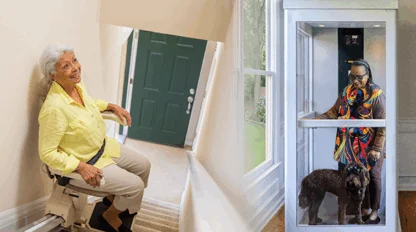
Aging in place—the ability to live safely and independently in your own home as you grow older—is the goal for nine out of ten older adults. But the home itself doesn’t always cooperate. Stairs that once felt like nothing become barriers. Upper floors become effectively off-limits. And the choice between safety and independence starts to feel like a choice at all. A residential elevator changes that equation completely.
By restoring full access to every floor, a home lift reduces dependence on caregivers, eliminates the physical and emotional toll of navigating stairs daily, and actively supports the kind of ongoing mobility that keeps people healthier longer. There’s a dignity to being able to move freely through your own home—to sleep in your own bedroom, access your own office, use your own spaces—that’s hard to put a number on.
In the short term, a home elevator means easier daily movement and less fatigue. Long-term, it future-proofs your home, so it can adapt to changing needs without requiring a move or a costly renovation down the road.
Comparing accessibility solutions:
| Feature | Stair Lift | Ramp | Residential Elevator |
| Full floor access | Partial (stairs only) | Ground floor only | All floors |
| Physical effort required | Low | Moderate | None |
| Independence level | Moderate | Moderate | High |
| Aesthetic impact | Visible on stairs | Significant | Minimal / stylish |
| Usable by all household members | Limited | Limited | Yes |
| Space required | Staircase width | Significant | Compact footprint |
For homeowners facing mobility challenges now or planning for the future, a residential elevator isn’t a luxury—it’s the most practical path to staying in the home you love while maintaining your independence and active aging lifestyle.
Enhancing Home Design and Interior Space
The word “elevator” used to conjure images of bulky machinery, industrial shafts, and serious construction. Modern residential elevators—especially the compact, shaftless models Pollock specializes in—bear little resemblance to that picture.
A shaftless elevator is designed to travel through a floor opening without a traditional enclosed shaft, dramatically reducing construction disruption and maximizing usable space. The footprint can rival that of a standard closet, making it a realistic addition even in homes that weren’t originally built with an elevator in mind.
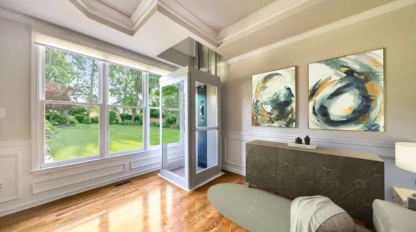
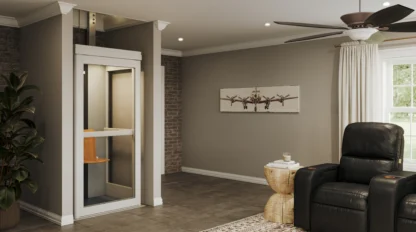
And today’s design options are genuinely beautiful. Frameless glass panels, ambient LED lighting, warm wood finishes, brushed metal accents, and biophilic materials turn a home elevator into an architectural feature—something that elevates (in every sense) the look and feel of a space, rather than detracting from it.
Space-saving and design integration tips:
- Choose a shaftless model to minimize structural modifications and preserve floor space
- Select finishes that match or complement your existing interior—flooring, millwork, hardware
- Consider frameless glass for an open, modern aesthetic that makes spaces feel larger
- Position the elevator to improve traffic flow between floors, not just as an add-on
- Use ambient LED lighting inside the cab to create warmth and a sense of luxury
- Work with a certified dealer to ensure the elevator enhances your floor plan, not interrupts it
Custom finishes available through Pollock include hardwood veneers, stainless steel, matte black, and bespoke painted interiors—so your elevator can feel like it was always part of the design.
Integration with Smart Home Ecosystems and Voice Control
Home technology has evolved dramatically, and residential elevators have kept pace. A smart elevator integrates digital technologies—including AI, voice activation, and IoT sensors—to deliver touchless controls, energy efficiency, and predictive maintenance capabilities that would have seemed futuristic just a decade ago.
For homeowners already invested in smart home ecosystems, the appeal is straightforward: your elevator can work alongside your lights, locks, thermostats, and security systems as a seamlessly connected part of your home.
Smart home integration features:
| Feature | What It Does | Available in Pollock Models |
| Touchless controls | App-based or sensor-activated floor selection | Yes |
| Standby / energy-saving mode | Reduces power draw when not in use | Yes |
| Battery backup | Ensures operation during power outages | Yes |
| Remote monitoring | Receive status alerts and diagnostics via smartphone | Yes |
| Predictive maintenance | IoT sensors flag potential issues before they become failures | Yes |
Pollock’s smart-ready models are designed to integrate with the platforms your household already uses, so adding smart home integration is a natural extension of your existing setup, not a separate project.
Effect on Property Value and Resale Potential
Beyond daily life, a residential elevator is a sound financial decision—and a growing one, as the buyer pool for accessible, future-ready homes continues to expand.
A home elevator can add roughly 4–10% to a property’s resale value, while simultaneously expanding the pool of potential buyers to include aging adults, multi-generational families, and anyone prioritizing long-term livability. Resale potential—the likelihood that a home will sell quickly and at a desirable price—is directly tied to how broadly it appeals, and accessibility features now rank among the most sought-after home attributes.
Home elevators also support what buyers increasingly call the “forever home” narrative: the idea that a property can adapt to life’s changes rather than requiring a move every decade. For aging-in-place buyers, that adaptability isn’t a nice-to-have—it’s the point.
Why accessible, future-proofed homes outperform the market:
- Appeal to a broader buyer demographic, including the fastest-growing segment of homeowners (adults 55+)
- Signal quality construction and thoughtful design to discerning buyers
- Reduce the likelihood of costly renovations post-purchase, making offers more competitive
- Support multi-generational living arrangements, which are increasingly common
- Align with universal design principles that improve livability for all ages and abilities
- Stand out in markets where comparable homes lack accessibility features
Planning for an elevator during new construction is the most cost-effective path—typically $20,000–$35,000, compared to $45,000–$80,000 for a retrofit. But either way, the investment tends to pay.
Installation Considerations and Home Adaptation
Understanding what installation involves helps you plan with confidence—and choose the right partner from the start.
New construction vs. retrofitting:
Installing a home elevator during new construction is significantly more cost-effective and less disruptive than adding one to an existing home. New-build installations typically range from $20,000–$35,000, while retrofitting an established home can run $45,000–$80,000, depending on structural requirements and the type of lift.
Retrofits often require reinforced load-bearing walls and, depending on the elevator type, may involve a pit beneath the unit or a small machine room. Shaftless lifts and pneumatic (vacuum) elevators generally require the least structural modification, making them the most practical retrofit option for most existing homes.
A checklist for preparing your home and working with certified professionals:
- Assess your floor plan – Identify candidate locations that minimize load-bearing wall interference and align on all floors
- Choose the right elevator type – Hydraulic, shaftless, and pneumatic models have different space, power, and structural requirements; a Pollock dealer can walk you through the tradeoffs
- Consult a structural engineer – Especially important for retrofits; ensures load-bearing walls and floor framing can support the installation
- Review local permitting requirements – Most jurisdictions require permits for home elevator installation; your dealer can help navigate this
- Plan for power and backup – Confirm electrical capacity and whether battery backup is needed for your usage profile
- Work with certified elevator professionals – Installation requires specialized knowledge; always use a licensed, ASME-certified installer
- Plan for ongoing maintenance – Most residential elevators require professional service twice a year to remain safe and compliant
At Pollock, our dealer network handles every step of this process—from initial site assessment through installation and ongoing maintenance support. The goal is a home adaptation that feels seamless, not stressful.
Frequently Asked Questions
How does a home elevator improve daily convenience and safety? A home elevator makes it easier and safer to move between floors by reducing physical strain, preventing stair-related falls, and simplifying tasks like carrying groceries or laundry. It also benefits the entire household—not just those with mobility challenges.
Will installing a home elevator increase my property’s resale value? Yes. Installing a home elevator often increases resale value because it appeals to buyers seeking accessibility, and can add approximately 4–10% to your property’s worth while broadening your buyer pool.
Can residential elevators be integrated with smart home systems and voice control? Many new home elevators—including Pollock’s models—offer smart home integration, with features like voice activation via Alexa or Google Home, touchless controls, remote monitoring, and battery backup.
How does a home elevator support aging in place and mobility challenges? A home elevator allows people with mobility challenges to access all floors independently, reducing reliance on stairs and caregivers, and enabling them to remain safely and comfortably at home as they age.
What maintenance does a home elevator require to ensure safe operation? Regular maintenance is essential. Most homeowners schedule professional servicing twice a year and address any changes in ride quality, unusual sounds, or operational issues promptly. Pollock’s dealer network provides ongoing service support to keep your elevator safe and reliable for the long term.
Ready to explore what a Pollock residential elevator could do for your home? Contact a dealer near you to schedule a free consultation.
Interested in Becoming a Distributor?
If you are looking to expand your product offerings or trying to reach a new market, then the Pollock Residential Elevator could be perfect for you. Reach out to our team to learn more.