Why Can’t Certain Elevators Travel More Than One Floor?
August 5, 2026
A lift is supposed to move between floors—so why might an installer say a particular model cannot travel beyond one floor?
The short answer is that “lift” and “elevator” describe several product categories with different safety standards, designs, and approved uses. A vertical platform lift (VPL), a traditional residential elevator, and a shaftless home elevator may all provide vertical access, but they are not interchangeable. Their maximum travel height depends on the product’s listing and certification, the code adopted where the home is located, and the structure available to support a safe installation.
There is also a language trap worth clearing up immediately: one floor of travel usually means moving between two landings or two stops—for example, from the first floor to the second. It does not mean the lift serves only one level. Understanding that distinction, and the product category behind it, can prevent an expensive mismatch between a homeowner’s needs and the equipment selected.
This guide explains why some products are intended for short-rise access, why some two-stop residential elevators are designed specifically for one-floor travel, and how to choose a solution that fits both today’s mobility and tomorrow’s plans.
The Difference Between a Platform Lift and a Home Elevator
The classification comes first because it shapes almost everything that follows: the applicable safety code, enclosure and guarding requirements, permitted travel, controls, inspections, and construction scope.
A vertical platform lift carries a standing passenger or a person using a wheelchair on a platform. VPLs are commonly used for relatively short changes in elevation, such as a porch, deck, garage entry, or split-level transition. Depending on the model and installation, the platform may be unenclosed, partially enclosed, or installed within a runway enclosure.
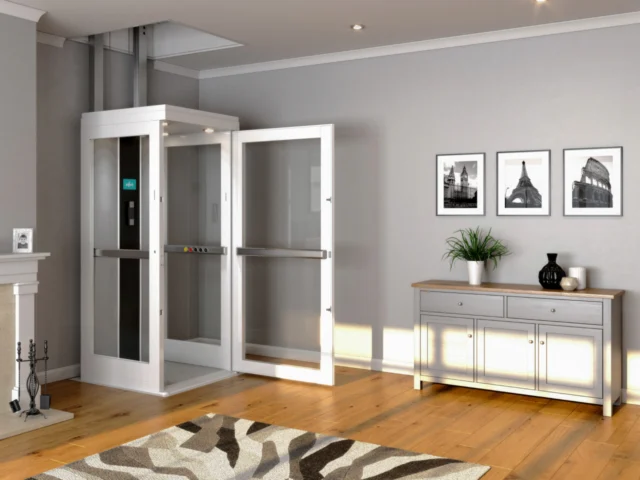
A private-residence elevator carries passengers in a car and is designed under the provisions that apply to residential elevators. Traditional models typically operate in a hoistway. Shaftless or through-floor elevators use a different configuration: the car travels through a carefully prepared floor aperture, often with an integrated supporting structure and without a conventional full hoistway.
A shaftless home elevator may be a compact, pitless home elevator, but “shaftless” does not mean “uncoded” or “structure-free.” The unit still needs an approved travel path, engineered support, landing protection, clearances, electrical work, and installation consistent with its listing and local requirements.
| Feature | Vertical platform lift | Residential elevator |
| Primary purpose | Short-rise accessibility for a passenger or mobility device | Passenger travel between levels of a home |
| Common standard | ASME A18.1, as adopted locally | ASME A17.1/CSA B44, as adopted locally |
| Typical travel | Limited; product and jurisdiction determine the maximum | One or more floor-to-floor runs, depending on model and approval |
| Traveling space | Platform with required guards or runway enclosure | Elevator car in a hoistway or an approved integrated/through-floor system |
| Construction | Often lighter for short-rise applications | Varies from a full hoistway to a compact floor aperture |
| Best fit | Porches, garages, decks, and small elevation changes | Routine movement between living levels |
Why Travel Limits Exist: Codes, Certification, and Local Approval
Travel limits are not arbitrary inconveniences. They are part of a larger safety system that considers the distance traveled, speed, platform or car configuration, landing protection, emergency operation, structural support, and risks around the moving equipment.
Different products follow different safety standards
In the United States, platform lifts are generally addressed by ASME A18.1, while private-residence elevators are generally addressed by ASME A17.1/CSA B44. The exact edition and amendments in force depend on the state or local jurisdiction. A model must be evaluated according to the category it was designed and certified to meet; calling a platform lift an elevator does not convert it into one.
The commonly quoted maximum travel of approximately 14 feet applies to certain VPL configurations under commonly adopted code provisions, but it should not be treated as a universal promise. Private-residence platform lifts, enclosed runways, local amendments, and product listings may be handled differently. The authority having jurisdiction (AHJ)—often a state elevator office, building department, or other designated agency—has the final say on what can be permitted at a specific property.
ADA rules do not replace residential building and elevator codes
The ADA Standards permit platform lifts in specified accessibility situations and reference ASME A18.1 for technical requirements. However, the ADA is not a shortcut around the building, elevator, fire-safety, or permitting rules that apply to a private home. In fact, many single-family homes are outside the ADA’s scope altogether. A homeowner should rely on the locally adopted requirements and the approved product documentation, not on a general statement that a lift is “ADA compliant.”
The product’s certified range matters
Every lift or elevator is designed around a defined travel range, rated load, speed, number of stops, and operating environment. Extending a unit beyond that approved configuration can alter loads on components, interfere with required clearances, and invalidate the basis on which the product was tested. It may also affect the warranty, inspection approval, and insurance coverage.
That is why a responsible installer will not improvise extra travel in the field. If the home requires more landings or a longer rise than a model supports, the answer is a product designed for that job—not a creative extension cord for an elevator.
Mechanical and Drive-System Limitations
A home elevator drive system is selected and engineered as part of a complete unit. Hydraulic, winding-drum, traction, screw-driven, pneumatic, and other systems can each be safe and effective when used within their intended designs. Drive type alone, however, does not tell a homeowner how many floors a product can serve.
The important questions are whether the complete system is listed for the proposed travel, how it is supported, how the car or platform is guided, what happens during a power loss, and whether the doors and landing protections operate correctly at every stop. Longer travel may require different rails, cables, cylinders, controls, braking provisions, overhead clearances, or supporting structure. More stops also add doors, interlocks, wiring, and opportunities for a landing to be unsecured if the system is not properly designed.
Repeated use matters, too. A unit selected for a frequent route between the kitchen, bedrooms, and laundry area may experience a different duty cycle than a porch lift used a few times a day. During a home accessibility assessment, the dealer should discuss expected use, passenger needs, mobility-device weight and dimensions, caregiver assistance, and whether groceries, laundry, or other household items may travel with the passenger.
How the Home’s Structure Limits Travel Distance
Vertical travel is not only a machine question. It is also a building question.
A short-rise VPL can often be positioned beside a porch, within a garage, or next to a small change in floor level. The project may still require a stable foundation, gates, guarding, electrical service, drainage, and permits, but it usually does not require cutting through an occupied floor.
Travel between stories changes the equation. The lift must pass safely through or alongside the building structure. A conventional residential elevator generally needs a continuous hoistway, suitable pit and overhead conditions, structural support, and protected entrances. Openings between stories can also raise structural and fire-separation questions that the design team must address.
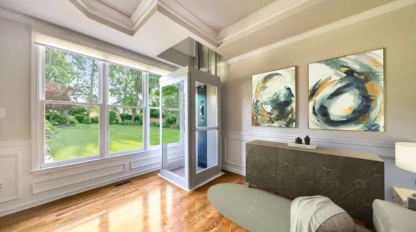
A through-floor lift solves this differently. Instead of constructing a traditional shaft, a precise aperture is created between the two levels. The elevator’s design closes or protects the opening as the car moves, and the installation must maintain required guarding and clearances. This approach can reduce the home elevator footprint and construction burden, but it is still a planned structural modification—not a portable appliance dropped into the corner.
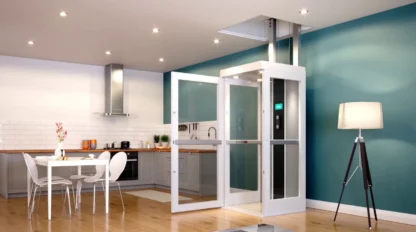
For many existing two-story homes, a two-stop shaftless elevator is intentionally engineered to connect the lower and upper living levels. Its one-floor travel limit is therefore not necessarily a shortcoming. It may be the design choice that keeps the system compact and the retrofit practical.
When a Single-Floor Lift Is the Right Choice
A limited travel range can be exactly right when it matches the barrier that needs to be removed. The goal is not to buy the product with the greatest possible travel. It is to create safe, comfortable access without adding construction and complexity the household does not need.
A VPL may be well suited to:
- A porch or deck above grade
- A garage floor below the home’s entry
- A split-level layout with a short rise
- An exterior entrance used by a wheelchair or mobility-scooter user
For those settings, a VPL can provide no-transfer access with a relatively direct installation. A user can remain in a wheelchair or on a compatible mobility device rather than transferring to a stairlift seat.
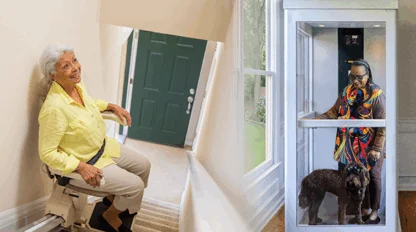
A two-stop shaftless home elevator may be the stronger fit when the central problem is the staircase between the main living level and the bedrooms. It can also help when a person uses a walker, has difficulty transferring, needs a caregiver nearby, or wants a more flexible way to move through the home.
This is an important mindset shift: changing access equipment is not evidence that someone has failed at using the stairs or a stairlift. Homes are adjusted throughout life—nurseries become offices, tubs become showers, and stairs sometimes stop fitting the people who live with them. Aging-in-place modifications are simply another way of making the home work better.
When to Consider a Multi-Stop Residential Elevator
A traditional multi-stop residential elevator deserves consideration when the home has three or more levels that must be served, the travel distance exceeds a shaftless model’s approved range, or the household needs a larger car and higher capacity than a compact system provides.
Common options include hydraulic, traction, winding-drum, pneumatic, and other proprietary residential systems. Capabilities vary considerably within each category, so homeowners should compare specific models rather than assuming every hydraulic elevator is large or every pneumatic elevator can reach the same number of floors.
| Solution | Often a good fit for | Construction considerations | Travel question to verify |
| Vertical platform lift | Short-rise wheelchair or scooter access | Foundation, guards/gates, power, and possibly a runway enclosure | Certified rise and permitted configuration |
| Two-stop shaftless elevator | Connecting two living levels in an existing home | Floor aperture, structural review, power, and landing clearances | Maximum floor-to-floor travel and two-stop limitation |
| Traditional residential elevator | Multiple landings, greater travel, or larger car needs | Hoistway, pit/overhead, equipment space, doors, and structural work | Number of stops, total travel, and rated capacity |
| Pneumatic/vacuum elevator | Certain retrofits where a self-supporting tube suits the layout | Diameter, overhead, landings, and model-specific requirements | Approved floors, travel, and capacity |
Cost should be evaluated as a complete installed project, not just an equipment price. Site preparation, structural engineering, permits, electrical work, finish carpentry, delivery conditions, options, and local labor can shift the total substantially. Published national ranges are useful for early budgeting, but a site-specific proposal is the only reliable comparison.
How to Choose the Right Travel Range for Your Home
Before selecting a lift, look beyond the staircase that is difficult today. A thoughtful home accessibility assessment should consider the household’s likely route, mobility changes, the building, and the practical realities of installation.
- Map the essential destinations. Identify where the bedroom, full bathroom, kitchen, laundry, garage, and primary exit are located.
- Count stops and measure total rise. Two stops can still represent one full floor of travel; three stops require a product approved for three landings.
- Plan for mobility devices. Confirm clear car or platform dimensions, door arrangement, turning space, rated capacity, and the combined weight of the user, device, and caregiver if applicable.
- Compare transfer requirements. A stairlift requires the user to transfer to a seat and may leave a second mobility device needed at the destination. An elevator or VPL can offer a no-transfer route when sized appropriately.
- Review the structure early. Have a qualified professional evaluate the aperture or hoistway location, joists, utilities, headroom, landing space, foundation, and emergency egress.
- Verify code and service support. Ask who secures permits, which standard and edition apply, what inspections are required, and who will maintain the equipment after installation.
- Consider the next five to ten years. If the household is likely to need additional stops, a larger mobility device, or caregiver assistance, include that possibility now.
The best recommendation may be a VPL, a two-stop residential elevator, a traditional multi-stop system, or a change to how rooms are used. A reputable professional should explain the trade-offs clearly and be willing to say when a simpler solution is enough.
Safety Standards and Professional Installation
Safe vertical access depends on the full installation: equipment, structure, electrical work, doors and gates, clearances, controls, emergency features, permits, and ongoing maintenance. The applicable requirements vary by jurisdiction, and some states regulate residential elevators more directly than others.
Before signing a contract, ask the installer to identify the product classification, governing standard, maximum approved travel, rated load, number of stops, permit responsibility, inspection process, warranty, maintenance schedule, and local service arrangements. Also ask what happens during a power outage and how a passenger can communicate or exit if the unit stops between landings.
Do not modify the travel, doors, controls, or safety devices after installation without authorization from the manufacturer and the professionals responsible for code compliance. Follow the manufacturer’s maintenance instructions and any inspection schedule required by the AHJ.
Pollock’s compact shaftless home elevators are designed to provide practical travel between levels while minimizing the space and construction commonly associated with a traditional hoistway. A Pollock home elevator specialist can review the intended route, available footprint, floor-to-floor distance, passenger needs, and local requirements to determine whether a two-stop through-floor lift is appropriate.
Frequently Asked Questions
Why are some home elevators limited to one floor?
Some models are intentionally designed and certified for one floor of vertical travel between two stops. The limit may reflect the product category, total approved travel, structural system, landing protection, or code requirements. It does not necessarily mean the product serves only one level.
What types of home lifts can travel only one story?
Many short-rise platform lifts and some compact shaftless or through-floor elevators are configured for a single floor-to-floor run. Exact limits vary by model, listing, installation, and jurisdiction, so verify the approved number of stops and maximum travel height in the product documentation.
Are vertical platform lifts restricted to single-floor travel?
VPLs are designed for limited vertical travel, and many residential applications connect two nearby landings. A commonly cited limit for certain configurations is about 14 feet, but requirements vary. The manufacturer’s approved configuration and the local AHJ determine what is allowed.
Can I modify a platform lift to travel farther?
No field modification should be made unless it is expressly approved by the manufacturer and accepted by the responsible code authority. Extending travel can affect structural loads, guiding, clearances, doors or gates, controls, certification, warranty, and safe operation.
Is a shaftless elevator the same as a platform lift?
No. A shaftless home elevator generally carries passengers in an enclosed car through a floor aperture using an integrated system. A VPL carries a passenger or mobility device on a platform and is governed as a different product category. Their construction, controls, safety provisions, and permitted travel may differ.
Can a shaftless elevator serve three floors?
Some shaftless or self-contained products may offer more than two stops, while others are engineered specifically for two. Do not infer capability from the word “shaftless.” Confirm the model’s approved number of stops, total travel, local acceptance, and structural requirements.
What is the best elevator for a two-story home?
For a home that needs access between two living levels, both a two-stop shaftless elevator and a traditional residential elevator may be viable. The better choice depends on space, capacity, construction tolerance, budget, passenger needs, and future plans. A site assessment can determine whether a compact floor aperture or a full hoistway makes more sense.
Choose the Solution That Fits the Home—and the Future
When a lift cannot travel beyond one floor, the reason is usually not a single mechanical weakness. It is the result of the product’s intended category, approved travel, safety features, and relationship with the building around it.
For a porch, garage entry, or short change in elevation, a VPL may solve the problem cleanly. For the primary staircase in a two-story home, a two-stop shaftless home elevator may offer a compact, no-transfer route with less construction than a traditional hoistway. For three or more landings, greater travel, or larger capacity, a multi-stop residential elevator may be the right long-term investment.
The most useful next step is a professional home accessibility assessment that measures the actual rise, confirms the number of stops, reviews the structure, and checks the locally adopted requirements. That turns “Why can’t this lift go farther?” into the better question: “Which solution is designed to take us where we need to go?”
Interested in Becoming a Distributor?
If you are looking to expand your product offerings or trying to reach a new market, then the Pollock Residential Elevator could be perfect for you. Reach out to our team to learn more.