Best Home Elevators Compared (2026): Stiltz, Savaria, PVE & More
April 7, 2026
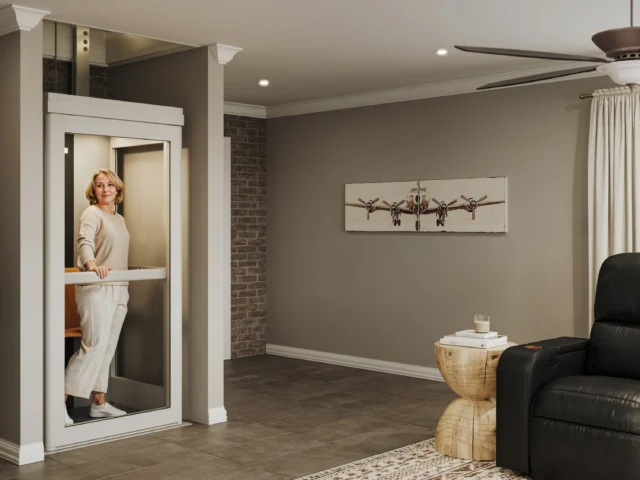
Choosing a home elevator isn’t just about getting from one floor to another—it’s about safety, independence, and long-term livability. With several leading brands on the market, it can be difficult to understand which solution truly fits your home and lifestyle.
In this guide, we compare some of the most well-known home elevator manufacturers—including Stiltz, Savaria, Stannah, PVE, Cibes, Staying Home, and other modern solutions—so you can make a confident, informed decision.
Quick Comparison of Top Home Elevator Brands
To cut down the confusion as we explore the various elevator manufacturers and lift types, we’ve outlined some of the key differences in a chart seen below:
| Brand | Elevator Type | Best For | Key Advantage | Considerations |
| Pollock | Shaftless, through-floor | Design-conscious homeowners | Sleek design, minimal construction | Higher upfront investment |
| Stiltz | Shaftless, self-supporting | Compact spaces | Small footprint, quick install | Limited customization |
| Savaria | Traditional & VPL | Variety of needs | Wide product range | More construction required |
| Stannah | Traditional elevators & lifts | Established brand trust | Long-standing reputation | Larger footprint |
| PVE (Vacuum) | Pneumatic vacuum | Modern aesthetics | Unique design, minimal footprint | Noise, ride feel varies |
| Cibes | Platform elevators | European-style accessibility | Clean design, modular | Slower travel speeds |
| Staying Home | Platform lifts | Budget-conscious accessibility | Functional solutions | Less design-focused |
Key Differences Between Home Elevator Types
Shaftless Elevators
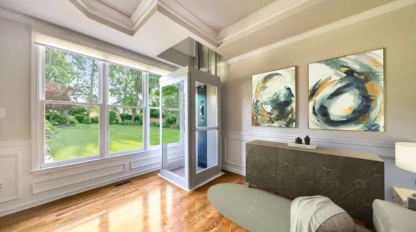
Shaftless elevators, like Pollock and Stiltz, are great for two-story homes and keeping the footprint to a minimum. Shaftless elevators are also known for minimally invasive installation (especially compared to other elevator types).
- Minimal construction required
- Ideal for retrofitting into existing homes
- Compact footprint
Traditional Elevators
Traditional elevators, like what you’ll find from Savaria and Stannah, are more involved and call for more intense installations. Because they require a hoistway or a shaft, that additional chute will take up more room compared to shaftless elevators. However, they can provide a lift to a wide range of users and specific needs do to their size and weight capacity.
- Require a hoistway or shaft
- Higher weight capacity and customization
Vacuum Elevators
PVE offers vacuum elevators. These lifts are more modern in their design and, instead of the boxy look you’ll find in most elevators, PVE’s elevator is actually cylindrical. While their sleek look is more than appealing in the modern home, vacuum elevators can be noisier due to their drive system.
- Air-driven system
- Modern, cylindrical design
Platform Elevators
Some platform elevators (like Cibes and Staying Home) are less about looks and more about functionality. Often, units can be more wallet-friendly and modular, while others are slower to get you where you need to go and aren’t necessarily optimal for residential use.
- Designed for accessibility over aesthetics
- Often used in commercial or hybrid settings
Which Home Elevator Is Best for Your Situation?
Best for Small Spaces
Because the following elevators have smaller footprints, they’re excellent for homes with limited space. Shaftless elevators, like the Pollock, require an aperture, which allows the elevator to pass through the floors and, when the cabin is parked on the first floor, the second-story room is open for full use.
- Stiltz
- Pollock
- PVE
Best for Long-Term Aging in Place
From warranties to longevity, the following elevators are optimal for aging-in-place and remaining in your forever home. The easy-accessibility points (like Pollock’s shallow entry ramp) and diverse dimensions, you can choose from an assortment of sizes from single-rider to having enough room for a mobility device.
- Pollock
- Savaria
- Stannah
Best for Wheelchair Accessibility
Due to the listed elevators’ structure and larger footprints, it’s much easier to find a cabin size that more comfortably fits a wheelchair and a second user at the same time. Combine that with the extra weight-lifting capacity, the following manufacturers might be best for wheelchair users who need constant care/assistance.
- Savaria
- Cibes
- Staying Home
Best for Modern Design
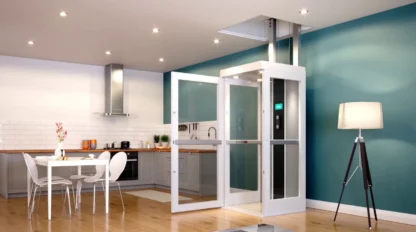
If aesthetics are what you’re after, Pollock and PVE offer a sleek, stylish, and more modern look. While Pollock’s cabin remains the traditional rectangular shape (unlike PVE’s cylindrical design), it is extremely customizable with optional mood lights, folding chair, choice of flooring, and more.
- Pollock
- PVE
Cost Considerations
Sticker shock can hit hard when first seeing the estimated price of an installed home elevator. This can be influenced by many factors, including drive system, elevator size, location, installation complexity, customization, and more.
General ranges:
- Platform lifts: $–$$
- Shaftless elevators: $$–$$$
- Traditional elevators: $$$–$$$$
The key is balancing upfront cost vs long-term usability.
Installation & Space Requirements
We’ve broken down the different types of elevators and established each has its own strengths. Below, we’ve narrowed down the amount of space each elevator type takes up:
- Shaftless models: Minimal structural work (learn about what an aperture is here)
- Traditional systems: Require shaft construction, which takes up more room on both floors
- Vacuum elevators: Self-contained with small footprint
- Platform lifts: Require more visible space
How to Choose the Right Home Elevator
We get it – it’s hard to figure out which will ultimately be the best choice for your needs, lifestyle, and home. So, during your research, ask yourself:
- Do I need wheelchair access now—or will I later?
- How long do I plan to stay in this home?
- Is design or function more important?
- What space constraints do I have?
FAQs
What is the smallest home elevator?
Shaftless and vacuum elevators typically have the smallest footprint.
Are home elevators worth it?
For long-term accessibility and aging in place, they often provide strong value compared to relocating. And compared to other options like stairlifts, residential elevators can grow with you in case any changes in your mobility occur in the future.
Which home elevator is best for existing homes?
Shaftless and vacuum models are typically easiest to retrofit.
Not Sure Which Option Fits Your Home?
The best solution depends on your home layout, mobility needs, and long-term goals.
Speak with a local expert to evaluate your space and get a tailored recommendation today!
Interested in Becoming a Distributor?
If you are looking to expand your product offerings or trying to reach a new market, then the Pollock Residential Elevator could be perfect for you. Reach out to our team to learn more.