Residential Elevator Installation: Elevators vs. Vertical Platform Lifts
February 9, 2026
Choosing between a residential elevator installation and a vertical platform lift (VPL) is less about “medical need” and more about how you want to live in your home—today and in the years ahead.
For homeowners planning to age in place, adult children supporting parents, caregivers, and mobility professionals, the real question isn’t “Which option is cheaper?”
It’s: “Which solution best supports independence, confidence, and long-term usability—given the home, the budget, and the person using it?”
Read on to learn all about the cost breakdowns, construction requirements, and long-term value of residential elevators versus VPLs, using real-life mobility scenarios and practical installation considerations to help you decide what truly fits.
The Path to Home Accessibility
The “Vertical” Challenge
In multi-story homes, stairs often become the first and most persistent barrier—not because someone “can’t” climb them, but because doing so becomes exhausting, painful, or unsafe over time.
Common scenarios include:
- Arthritis that makes stair climbing unpredictable
- Balance issues that increase fall risk
- Reduced leg strength or endurance
- Fatigue from chronic conditions
- Caregivers assisting a loved one up and down floors
When stairs limit access to bedrooms, bathrooms, or laundry, vertical mobility solutions restore full-home access—without forcing lifestyle compromises.
The Core Difference: Elevator vs. VPL
The most important distinction comes down to enclosure, travel distance, and integration.
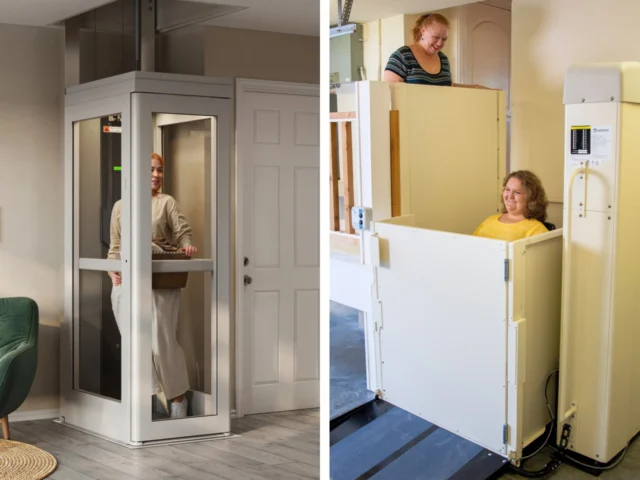
- Residential Elevators
Travel inside a fully enclosed cab within a constructed hoistway. Designed for multi-floor use and long-term daily living, they blend into the home like a permanent architectural feature. - Vertical Platform Lifts (VPLs)
Use an open or semi-enclosed platform that moves vertically, typically serving short rises (one or two stops). They are purpose-built accessibility tools with minimal construction.
This difference impacts everything from privacy and comfort to installation complexity and resale value.
Overhead Clearance Considerations
Overhead clearance—the space above the top landing—is a key planning factor.
- Residential elevators typically require more overhead clearance to accommodate the drive system and cab structure.
- VPLs often require less overhead space, making them easier to install in garages, porches, or tight interior areas.
Understanding overhead clearance early prevents redesigns later in the project.
Electrical & Mechanical Logistics
Powering Your Lift
Electrical requirements vary by system:
- Residential elevators usually require a dedicated circuit, often 220V, depending on the drive system. Backup battery systems are commonly integrated for peace of mind during power outages.
- VPLs may operate on 110V or 220V, depending on model and lifting capacity, and also require a dedicated circuit.
Planning electrical access early is a critical part of the pre-installation site survey.
Drive Systems and Installation Impact
Different drive systems influence noise, maintenance, and construction complexity:
- Screw drive: Compact, reliable, and well-suited for residential retrofits.
- Hydraulic: Smooth ride quality, but may require a machine room or additional space.
- Cable drum: Space-efficient with proven performance for residential use.
The drive system selected affects installation time, long-term maintenance, and acoustic comfort—especially important in lived-in homes.
Retrofitting: Integration into Existing Homes
The Closet-to-Closet Strategy
One of the most common and elegant retrofit solutions is a closet-to-closet elevator conversion.
By stacking closets vertically across floors, homeowners can:
- Minimize visible construction
- Preserve existing layouts
- Integrate the elevator discreetly into the home’s design
This approach is frequently used in residential elevator installations where aesthetics matter just as much as function.
Through-Floor Lift Installation
Through-floor lifts travel directly through the floor without a full hoistway.
Key considerations include:
- Cutting and reinforcing joists
- Maintaining fire separation and structural integrity
- Coordinating travel paths with existing utilities
Through-floor solutions can work for both elevators and platform lifts, but structural evaluation is essential.
Outdoor VPL Installations
For porch, deck, or garage access, outdoor VPLs are often the most straightforward solution.
Benefits include:
- Minimal interior renovation
- Weather-rated components
- Direct access from grade level
Outdoor installations also simplify the residential lift permit process in many municipalities.
VPL Installation Essentials
Concrete Pad Requirements
Most VPLs require a concrete pad to ensure stability and load distribution.
Key factors include:
- Pad thickness and reinforcement
- Drainage for outdoor installations
- Clearance for gates and safety features
These VPL concrete pad requirements are typically simpler than elevator foundations.
The “Plug-and-Play” Advantage
VPLs are often described as “bolt-down” systems:
- Minimal framing
- Faster installation timelines
- Lower labor costs
This makes them appealing for short-term needs or urgent accessibility upgrades.
Footprint & Turn Radius
Understanding VPL footprint dimensions is critical for wheelchair users.
Consider:
- Platform size
- Required turn radius for safe entry and exit
- Clearance at landings
Elevators generally offer more interior flexibility, while VPLs are optimized for direct, functional movement.
Permitting, Compliance, and Safety
Navigating Codes
Residential elevators and VPLs follow different ASME standards, which affect:
- Design requirements
- Inspection criteria
- Permitting documentation
Your installer will guide this process, but knowing the difference helps set expectations.
The Permit Process
The residential lift permit process typically includes:
- Engineered drawings or manufacturer specifications
- Electrical permits
- Final inspections after installation
Timelines vary by municipality, but early coordination prevents delays.
Final Safety Inspection
Inspectors typically review:
- Emergency stop functionality
- Obstruction sensors
- Gates and interlocks
- Weight capacity compliance
Both elevators and VPLs are designed to meet strict safety standards when properly installed.
Cost vs. Value Analysis
Upfront Installation Costs
A residential elevator installation cost is generally higher due to:
- Hoistway construction
- Electrical and mechanical integration
- Finish work
VPLs typically have lower upfront costs due to reduced construction and labor.
Long-Term Home Value
- Residential elevators are often viewed as a luxury amenity, increasing market appeal and resale value.
- VPLs are seen as functional accessibility solutions, valuable for usability but less impactful on equity.
For homeowners planning long-term occupancy, the value equation often favors elevators.
Maintenance & Longevity
- Elevators usually require annual inspections and benefit from long service life.
- VPLs may require more frequent component checks due to exposed mechanical elements.
Maintenance planning is a key factor for long-term satisfaction.
Final Verdict: Which Is Right for You?
Choose a Vertical Platform Lift if:
- You need a cost-effective solution
- The rise is short (one to two levels)
- Construction time must be minimal
- The primary user uses a wheelchair full-time
Choose a Residential Elevator if:
- You want seamless access across multiple floors
- Long-term home value matters
- Privacy, comfort, and aesthetics are priorities
- You’re planning proactively for aging in place
Take the Next Step
Every home—and every mobility story—is different. The most reliable way to determine feasibility is through a professional pre-installation site survey, where structural constraints, electrical access, and layout options can be evaluated accurately.
Frequently Asked Questions About Elevators vs. VPLs
How much more does it cost to install an elevator compared to a VPL?
Residential elevators typically cost more due to construction and finish work.
What electrical requirements are needed?
Both require dedicated circuits; elevators often use 220V.
How much space is required for a VPL footprint?
Footprints vary, but wheelchair turn radius must be considered.
Can VPLs be installed outdoors?
Yes, many are designed specifically for exterior use.
Which option adds more resale value?
Residential elevators generally provide greater long-term equity impact.
Interested in Becoming a Distributor?
If you are looking to expand your product offerings or trying to reach a new market, then the Pollock Residential Elevator could be perfect for you. Reach out to our team to learn more.