There’s a particular kind of frustration that comes with waking up stiff and knowing that the coffee maker – and pretty much everything else you need – is on a different floor.
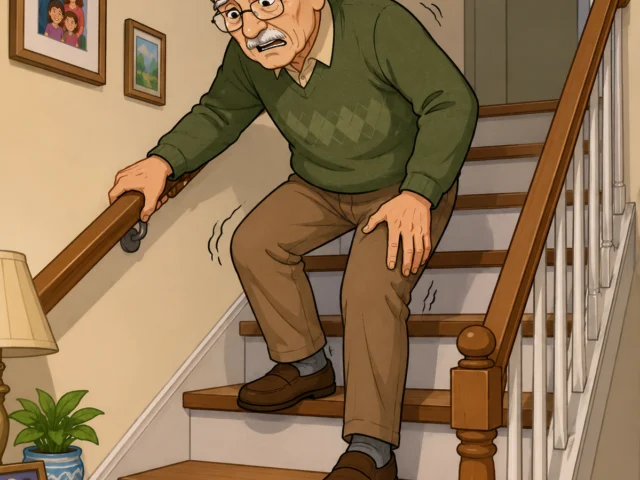
If arthritis is making your stairs harder to manage, you’re not alone. It’s one of the most common challenges that comes with joint pain, and it tends to sneak up gradually – what was once effortless starts to feel like a negotiation with your own body every time you approach the landing.
The good news is that there are practical solutions at every level of need, from small changes you can make this weekend to long-term home access solutions that remove the stairs from the equation entirely. This guide walks through all of them, starting with the simplest and building toward the most complete.
Why Stairs Are So Hard With Arthritis
It’s not just pain – it’s physics. Climbing stairs puts significantly more force through the knee joint than walking on flat ground. Research published in Arthritis Care & Research found that stair climbing was one of the most common pain triggers for people with knee osteoarthritis, precisely because of how weight shifts and compresses the joint with each step.
Hip and ankle arthritis follow a similar pattern – the loading and rotation required to climb stairs hits the exact joints that are already inflamed and sensitive. Add in the balance and coordination challenges that often come with arthritis, and stairs become a genuine fall risk, not just a source of daily discomfort.
There’s also the psychological piece. A lot of people with arthritis start to avoid the stairs, which means avoiding whole rooms of their home. Bedrooms, laundry, grandkids’ playrooms – entire levels of the house become off-limits. That loss of access is significant, and it doesn’t have to be permanent.
Quick Fixes: Small Changes That Help Right Now
Before making any major investment, there are several low-cost changes that can meaningfully reduce daily stair difficulty:
- Install handrails on both sides of the staircase if you don’t already have them. A second rail gives you a stable anchor on the way up and a controlled brake on the way down – especially useful on bad days.
- Add non-slip stair treads. Slippery stairs compound the fall risk that arthritis already creates. Rubber or textured treads are inexpensive and easy to install.
- Improve stair lighting. Poor lighting is a fall multiplier. A well-lit staircase gives your eyes the information they need to compensate when your joints are less reliable.
- Move things you use most often to the main level. Medications, phone chargers, daily essentials – anything that’s pulling you up and down stairs unnecessarily is worth relocating.
- Wear supportive shoes, even at home. Arch support reduces the inward knee collapse that makes stair climbing more painful. Barefoot or in unsupportive slippers is harder on arthritic joints than it looks.
- Use a messenger bag or backpack when carrying things up stairs. Keeping both hands free to hold the rail is safer than trying to carry a bag and grip at the same time.
None of these eliminate the underlying challenge, but they reduce the daily friction and the fall risk while you figure out a longer-term plan.
Mid-Level Solutions: Mobility Aids for Stair Challenges
For people dealing with moderate difficulty — stairs that are manageable but painful — mobility aids can provide meaningful support without requiring any home modifications:
Stair assist rails with ergonomic grips are designed specifically for people with limited hand dexterity. Some models have a bar that moves with you and locks if you lose balance.
Walking canes — if you use one, the correct technique on stairs matters. Lead with your stronger leg going up (“up with the good”), and lead with the cane and weaker leg going down (“down with the bad”). Your physical therapist can walk you through this.
Knee braces and compression sleeves can reduce pain and improve joint stability during stair use, particularly for osteoarthritis. They don’t fix the problem, but they can make daily navigation more bearable.
Forearm crutches distribute more weight to the upper body, which can significantly reduce load on arthritic knees and hips during a severe flare-up.
These aids are genuinely helpful for mild-to-moderate limitation. But they have a ceiling. As arthritis progresses, or on the harder days that come with any chronic condition, the assist only goes so far. That’s when structural home modifications start to make sense.
Long-Term Solutions: Structural Home Accessibility Changes
This is where the real difference gets made – solutions that change the physical structure of your home rather than asking you to work harder to navigate it.
Stairlifts: A Great Option for Many Arthritis Sufferers
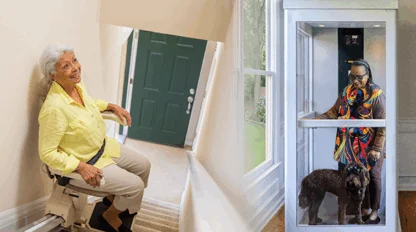
A stairlift is a motorized seat that travels along a rail mounted to your staircase. You sit down, ride up or down, and stand at the other end. No stair climbing required.
For people with arthritis, stairlifts reduce joint strain significantly – your knees, hips, and ankles aren’t bearing weight through each step. They also reduce fall risk on the stairs, which is one of the most significant safety concerns for older adults with arthritis.
Harmar’s stairlift line includes straight and curved options, with features like ergonomic controls that work even with limited hand dexterity, swivel seats for easy entry and exit, and retractable seatbelts. Models are available for both indoor and outdoor use.
The honest limitation: Stairlifts work best for people who can sit and stand independently and have reasonable upper body stability. If you use a wheelchair, or if your arthritis has progressed to the point where transferring to a lift seat is difficult or painful, a stairlift becomes a less complete solution.
Home Elevators: Full Independence Between Floors
A home elevator removes the stairs from the equation entirely. You step in on one floor and step out on another – no transferring, no handrails, no negotiating with your joints.
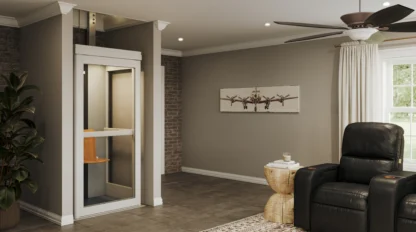
The Pollock residential elevator is a shaftless design, which means it doesn’t require a traditional hoistway built into your home’s structure. It runs on two rails mounted near a wall and installs with minimal construction. The cab is large enough to accommodate wheelchairs, walkers, and powerchairs – so it works for virtually any mobility level, now and in the future.
For someone with progressive arthritis, this matters a lot. A stairlift might meet your needs today, but if your condition advances or you eventually need a mobility device, you’d need to replace it. An elevator doesn’t have that limitation – it scales with you.
A 2025 study in Healthcare (Basel) found that home modifications – including structural stair adaptations – were effective in 65% of reviewed studies for fall prevention and functional independence. An elevator is among the most comprehensive of those modifications.
Home elevators also improve home value and make a multi-story home accessible to a broader range of future buyers, which is worth factoring into the investment decision.
First-Floor Living Conversion
For some people, the cleanest solution is reorganizing the home so that the stairs simply become irrelevant to daily life. That means moving the bedroom to the main level, and if needed, adding a first-floor bathroom or converting an existing space.
This works well in homes where the layout allows it, and for people who want to eliminate stair use rather than manage it. It doesn’t require ongoing maintenance, and it’s often less expensive than a full stairlift or elevator installation – though the trade-off is that it doesn’t give you access to upper floors at all.
How to Choose the Right Solution for Your Situation
There’s no single right answer, but there is a useful framework for thinking it through:
| Mild difficulty: Quick fixes (handrails, non-slip treads, lighting) + mobility aids (canes, braces) are likely enough for now. Revisit as your condition changes. Moderate difficulty: A stairlift may be the right fit — especially if you’re still mobile and independent. Consider your staircase layout and whether you can sit and transfer comfortably. Severe or progressive arthritis: A home elevator is the most future-proof option. It accommodates any mobility device, eliminates stair use entirely, and doesn’t need to be replaced as your needs change. Limited multi-story needs: A first-floor conversion might be simpler and more cost-effective if you can make the main floor work for daily life. |
An occupational therapist can be genuinely useful here — they’re trained to assess your specific mobility challenges and recommend home modifications that match your actual needs. If you’re unsure where to start, a home mobility assessment is a worthwhile first step.
Frequently Asked Questions
What is the best way to go up stairs with arthritis?
Lead with your stronger leg going up and use a handrail for support. Wearing supportive shoes, taking it slowly, and not carrying items in your hands (use a backpack instead) all reduce strain. On particularly difficult days, a stairlift or home elevator removes the need to navigate stairs at all.
Is a stairlift or home elevator better for arthritis?
It depends on your mobility level. A stairlift works well if you can sit and transfer independently. A home elevator is the better fit if you use a mobility device, have significant joint limitations, or want a solution that will remain appropriate as your condition progresses over time.
How can I make my stairs safer if I have arthritis?
Start with handrails on both sides, non-slip stair treads, and improved lighting — those three changes address the biggest fall risk factors. From there, consider whether a mobility aid or a structural modification like a stairlift would reduce your daily difficulty further.
Can a home elevator help with severe arthritis?
Yes — and it’s often the most complete solution for severe or progressive arthritis. A home elevator eliminates stair use entirely and accommodates wheelchairs, walkers, and powerchairs. The Pollock residential elevator installs with minimal construction and works across all floors of a two-story home.
Are there mobility aids specifically designed for arthritis?
Yes. Stair assist rails with ergonomic locking grips, forearm crutches, and stairlifts with low-force controls are all designed with arthritis sufferers in mind. Harmar’s stairlift line, for example, includes ergonomic controls usable with limited hand dexterity, which is a common arthritis complication.
You Shouldn’t Have to Choose Between Arthritis and Your Home
Whether you’re exploring a stairlift for right now or planning for the long term with a home elevator, Pollock and Harmar have solutions built around real mobility needs. Contact a dealer for a free consultation — we’ll walk you through the options and help you find what actually fits your home and your life.
Interested in Becoming a Distributor?
If you are looking to expand your product offerings or trying to reach a new market, then the Pollock Residential Elevator could be perfect for you. Reach out to our team to learn more.